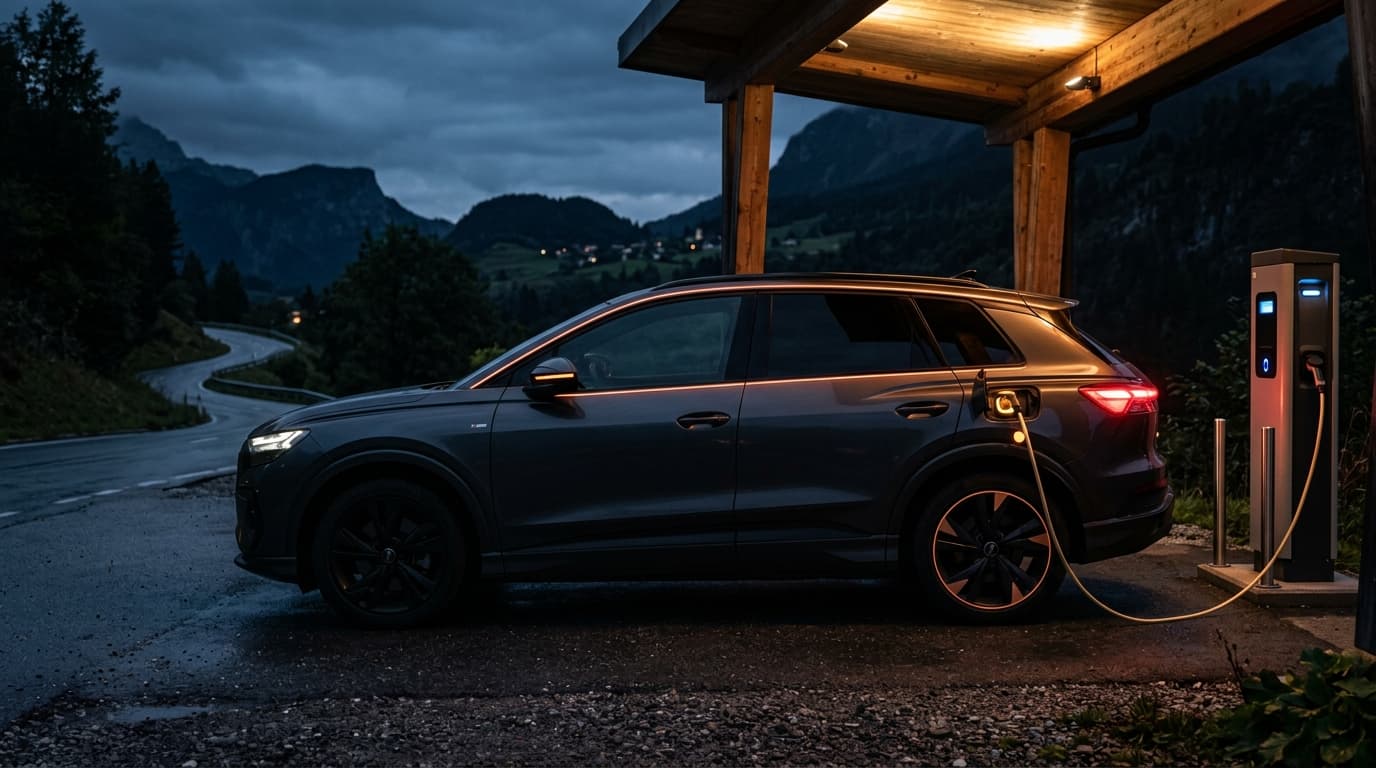
In Belgium, the best electric SUV for real-world range is currently the Tesla Model Y: around 600 km WLTP, but above all 16.5 kWh/100 km recorded at 130 km/h, the lowest consumption in our selection. On a tighter budget, the Skoda Enyaq 85 and the Kia EV6 Long Range follow, provided you go for the large battery.
Which electric SUV has the best real-world range in Belgium?
The Tesla Model Y comes out on top. With 16.5 kWh/100 km measured on the motorway at 130 km/h, it holds close to 400 km per charge in mixed use. The Kia EV6 Long Range (647 km WLTP) and the Skoda Enyaq 85 complete the podium, ahead of the thirstier Renault Scénic E-Tech.
The gap between the spec sheet and the road is the real story. The WLTP figure is measured in a lab at moderate speed; on a Belgian motorway at 120-130 km/h, consumption rises by 30 to 50 %. The automobile-propre Supertest recorded 25.3 kWh/100 km on the Scénic E-Tech over a 500 km motorway run, versus 22.8 kWh/100 km for the Skoda Enyaq 85 measured by L'Argus. Two SUVs rated around 600 km WLTP, but a real efficiency that clearly separates their practical range.
In practice, a Brussels-Arlon trip (around 190 km) is covered without recharging by any of these models in summer. In winter, with an evening return leg, it is another matter: only the models under 18 kWh/100 km do it again without stopping at a charger. The number that counts is not WLTP range, but real motorway consumption.
Why does range drop so much in a Belgian winter?
In hard frost, expect 20 to 30 % less range. The battery delivers its energy less well at low temperatures and the cabin heating draws directly from the traction current. An SUV rated for 450 km in summer falls to around 320 to 360 km at 0 °C.
The data confirms it. TCS compared 14 family electric cars at an average temperature of 0 °C over a 580 km long-distance route: real range, consumption and charging speed do not fall the same way from one model to another. SUVs fitted with a heat pump as standard cope with the cold better than those that heat the cabin with an electric resistance.
Does a heat pump really make a difference?
Yes, especially between November and March. It recovers heat from the drivetrain and battery instead of producing it entirely from traction current. On a winter trip, the difference can reach several dozen kilometres. What we would avoid: a model where the heat pump remains a paid option, since it is rarely ticked when ordering and then sorely missed in use.
Battery preconditioning: useful or gimmick?
Useful, and free in energy when the car is plugged in. Preheating the battery before an early start or before a fast charger reduces the loss of charging power in cold weather. On 800 V models such as the Kia EV6, the time saved at the charger is clear: the architecture recharges far faster than 400 V SUVs.
Comparison: range, consumption and price
The table cross-references WLTP range, motorway consumption (measured where a source exists, otherwise estimated), an estimated winter range at about WLTP −25 %, and the indicative Belgian list price excluding options and grants.
| Model | WLTP | Motorway use | Winter (est.) | BE price from |
|---|---|---|---|---|
| Tesla Model Y | ~600 km | 16.5 kWh/100 | ~400 km | ~€46,000 |
| Kia EV6 Long Range | 647 km | ~18 kWh/100 | ~420 km | ~€50,000 |
| Skoda Enyaq 85 | ~560 km | 22.8 kWh/100 | ~340 km | ~€47,000 |
| Renault Scénic E-Tech | 620 km | 25.3 kWh/100 | ~360 km | ~€45,000 |
| Volkswagen ID.4 | 554 km | ~21 kWh/100 | ~330 km | ~€46,000 |
| BMW iX3 | ~700 km | ~19 kWh/100 | ~560 km | ~€70,000 |
The BMW iX3 plays in another price bracket, but its roughly 100 kWh usable battery exceeds 700 km in summer on secondary roads and stays around 560 to 580 km in winter. On a contained budget, the Model Y's efficiency and the Kia EV6's large battery remain the best range-to-price compromises on the Belgian market.
Which electric SUV should you choose for your use?
For a family driving daily without long motorway trips, the Skoda Enyaq 85 and the Volkswagen ID.4 are more than enough: a 585 L boot for the Enyaq, home charging overnight, and a winter range of 330 to 340 km that covers a week of school runs and errands. There is no point paying for 650 km WLTP if you charge at home.
For a high-mileage motorway driver clocking up 300 km legs, the Tesla Model Y and Kia EV6 Long Range pairing stands out: low consumption at 130 km/h for the former, 800 V architecture and a large battery for the latter. On a Brussels-Cologne run, the EV6 recovers most of a charge in about twenty minutes at a fast charger.
For urban use or a second car, aiming for an electric SUV with 650 km of range makes no sense: you carry a heavy, expensive battery for nothing. A more compact, lower-capacity model costs less to buy and to insure.
For a company-car driver, the calculation shifts: tax deductibility and the benefit-in-kind weigh more than 20 km of extra range. That is the subject of the next section.
Does Belgian 2026 taxation change the choice?
Yes, especially as a company car. A 0 g CO₂ electric SUV bought before end-2026 remains 100 % deductible over its full depreciation period, while combustion engines see their deductibility tighten. For a company, electric is no longer just green, it is fiscally the only rational choice.
For private buyers, a purchase grant is no longer in the picture. In Flanders, the grant for private buyers closed in November 2024, and every new electric vehicle there now pays a flat registration tax (TMC, the vehicle registration tax) of about €61.50 plus a minimum annual tax. In Wallonia, there was never a private grant, but the reform of the registration tax now factors in weight, CO₂, power and maximum authorised mass.
In practice, on the Belgian market, a household with three children registering an electric SUV whose registration tax would reach €334 pays only €84 after reduction, according to the examples published on the Walloon reform. The tax advantage has shifted: fewer direct grants, but a circulation-based tax and company deductibility that still favour electric.
Which electric SUVs should you avoid, and why?
For a high-mileage driver, avoid entry-level versions under 60 kWh of battery. On the motorway, their real winter range drops below 250 km, which multiplies stops. The extra cost of the large battery quickly pays off in time saved at chargers.
Be wary too of the electrical architecture. A 400 V SUV charges noticeably more slowly than an 800 V model such as the Kia EV6 or the Audi A6 e-tron, which recovers up to 300 km in 20 minutes thanks to this technology. For anyone who drives a lot, those minutes matter more than ten extra kilometres on the spec sheet.
A final trap, relevant for company cars: confusing an electric SUV with a plug-in hybrid (PHEV). An unplugged PHEV consumes as much as a combustion engine and loses the tax advantage reserved for 0 g CO₂ vehicles. If the goal is 100 % deductibility, only the fully electric ticks the box.
Frequently asked questions
The Tesla Model Y, thanks to 16.5 kWh/100 km measured on the motorway at 130 km/h, or close to 400 km per charge in mixed use. The Kia EV6 Long Range (647 km WLTP) and the Skoda Enyaq 85 follow closely.
In hard frost, expect a 20 to 30 % drop according to TCS tests. An SUV rated for 450 km in summer falls to around 320 to 360 km at 0 °C with the heating on.
For winter driving in Belgium, yes. It recovers heat from the drivetrain and battery instead of drawing from the traction current, saving several dozen kilometres in cold weather. Check that it is standard, not a paid option.
Yes for a 0 g CO₂ vehicle bought before end-2026: it remains 100 % deductible over its full depreciation period, while combustion engines see their deductibility shrink. It is the strongest tax argument right now.
No in Flanders, where the private grant closed in November 2024, and no in Wallonia, which never had a private grant. Wallonia has, however, reformed its registration tax (TMC) based on weight and CO₂.
Entry-level versions under 60 kWh of battery and 400 V architectures, which charge more slowly. On the motorway they force stops that are too frequent and too long for a high-mileage driver.
Aim for at least 350 km of real winter range for daily use, or about 500 km WLTP. Below that, charging becomes a constraint as soon as it is cold or the car is loaded.
We dig through the Belgian market data — TÜV reliability, real-world ADAC consumption, company-car taxation, list prices — to call it straight. No brand pays us.